Grid Mattress vs. Latex Mattress: Choosing Your Champion
The quest for perfect sleep often leads to a showdown between two modern heavyweights: the innovative Grid Mattress and the classic Latex Mattress. Both promise superior comfort, support, and temperature regulation, but they achieve these goals in fundamentally different ways. Understanding their core differences is key to choosing the right one for your needs.
This isn’t about which is objectively “better,” but about which is better for you.
Round 1: Material & Origins
-
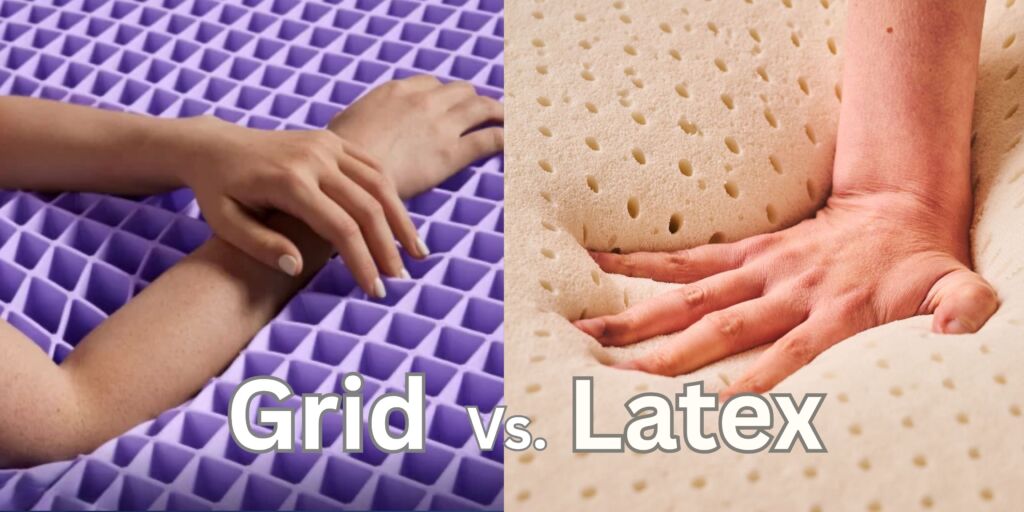
Grid Mattress: The top layer is a synthetic polymer, a hyper-elastic foam engineered into a distinctive honeycomb grid. It’s a marvel of modern chemical engineering, designed in a lab for specific performance traits like pressure relief and cooling. The base layers are typically high-density polyfoam or coils.
-
Latex Mattress: The comfort layer is Natural or Blended Latex, derived from the sap of rubber trees. It’s a renewable, natural material that is whipped and baked (Dunlop or Talalay process) into foam. It represents a more traditional, nature-derived approach to comfort.
Winner for Natural Origins: Latex. If you prioritize a natural, bio-based sleep surface, latex is the undisputed champion.
Round 2: Feel & Support
-
Grid Mattress: Offers a unique “on-top” feel. The grid columns collapse under your heaviest points (hips, shoulders) for pressure relief while providing firmer support elsewhere. The feel is often described as gel-like, soft-yet-firm, and highly responsive. It’s a dynamic, “active” support.
-
Latex Mattress: Provides a buoyant, “floating” feel. It contours to your body but pushes back evenly with resilient support. You sink in slightly more than on a grid but are firmly cradled and supported. The feel is consistently bouncy and upliftiing.
Winner for Unique, Targeted Feel: Grid. Winner for Buoyant, Even Support: Latex. This is pure preference. Try both if you can.
Round 3: Temperature Regulation
-
Grid Mattress: The clear honeycomb structure is its greatest asset here. The large open air channels allow for exceptional airflow, actively pulling heat away from the body. It consistently ranks as one of the coolest sleeping surfaces available.
-
Latex Mattress: Also sleeps very cool, especially Talalay latex, which has a more open-cell structure than Dunlop. It is non-heat-retentive and breathable, a massive improvement over memory foam. However, it doesn’t have the same active airflow mechanism as a grid.
Winner for Ultimate Cooling: Grid. For exceptionally hot sleepers, the grid’s design has a slight edge.
Round 4: Durability & Longevity
-
Grid Mattress: Made from highly durable polymers designed to resist sagging and permanent impressions. However, as a newer technology, its multi-decade track record is still being established. Most brands offer very long warranties as a sign of confidence.
-
Latex Mattress: The proven longevity champion. High-quality natural latex cores are known to maintain their support and integrity for 20 years or more without sagging. It has a century-old reputation for incredible durability.
Winner for Proven Longevity: Latex. Its reputation for lasting decades is well-earned.
Round 5: Eco-Friendliness & Allergies
-
Grid Mattress: As a synthetic material, its environmental footprint is a consideration. While many brands use CertiPUR-US® certified foams (free of harmful chemicals) and promote durability to reduce waste, the core material is not biodegradable or derived from renewable resources.
-
Latex Mattress: The natural choice. Natural latex is sustainable, biodegradable, and renewable. It is also inherently resistant to dust mites, mold, and mildew, making it the ideal choice for allergy and asthma sufferers. (Note: Those with a latex allergy should avoid it).
Winner for Sustainability & Allergies: Latex. It is the superior choice for the eco-conscious and allergy-prone sleeper.
Round 6: Noise & Motion Transfer
-
Grid Mattress: May produce faint breaking-in sounds (a soft crunching or squishing) for the first few days as the grid structure adapts. This usually fades. It is otherwise very responsive with minimal motion transfer.
-
Latex Mattress: Virtually silent. No break-in period sounds. Its resilience minimizes motion transfer, making it an excellent choice for couples.
Winner for a Silent Sleep: Latex.
The Final Verdict: Which Should You Choose?
Choose a Grid Mattress if:
-
You sleep very hot and need maximum cooling.
-
You want a unique, soft-yet-firm feel with highly targeted pressure relief.
-
You like the idea of a modern, engineered sleep technology.
-
A slight break-in noise doesn’t bother you.
Choose a Latex Mattress if:
-
You prioritize natural, sustainable, and non-toxic materials.
-
You need a hypoallergenic surface resistant to allergens.
-
You want a proven, durable mattress that will last for 20+ years.
-
You prefer a buoyant, responsive, and consistently supportive feel.
Ultimately, your choice depends on what you value most: the cutting-edge, engineered performance of the grid or the proven, natural integrity of latex. Both are excellent options that stand far above traditional memory foam, just for different reasons.